Karl Shook


Doctor Who
The fiftieth anniversary of the British science fiction television show Doctor Who was on November 23, 1963. My career in writing began wth my writing about Doctor Who. I will use this page to discuss the history of the program and the people I've known involved with the show And I hope to post articles I've written about the program. Keep your eyes open. Doctor Who is a passion of mine.
- The Beginning: An Earthly Child
Doctor Who began on November 23, 1963. It followed the BBC's coverage of the John F. Kennedy assination, which occured the previous day. The British people were so upset about the death of the American president few viewers saw the opening of the new science fiction program. So, the first episode was repeated the next Saturday immediately before the second episode was aired.
The opening episode was an An Unearthly Child. It began with a police officer walking through a junk yard with the theme playing in the background. The officer's flashlight reveals different pieces of junk lying about. Finally, the light falls on a London police call box. The scene switches to day at a London school. Two teachers Ian Chesterton(William Russell) and Barbara Wright (Jacqueline Hill) are discussing a strange student Susan Foreman (Carol Ann Ford). Susan knows the results of science experiments before they're conducted, but she doesn't know how to make change. Out of concern for the girl (and curiousity) they go to Susan's address; a junk yard. They watch Susan go in the entrance from across the street. In the dark of night, they find their way inside the fence. To the surprise of both Ian and Barbara there is only the usual junk of a junk yard and a police call box. There appears to be nothing there for someone to live in.They call out for Susan, but receive no answer. They touch the box and feel that power is going through it. Suddenly, they hear someone coming, and hide behind some junk. An elderly man walks into the yard and opens the door to the box. The teachers hear Susan call out from inside the box. They come out from their hiding place and the man shuts the door from outside. During a long and frustrating conversation with the man, Susan opens the door to see what's going on. Ian and Barbara force their way inside. They are shocked to find themselves inside a large futuristic control room. The man, who calls himself the Doctor(William Hartnell) and Susan, his granddaughter, explain that they are exiles from another planet in the far distant future. They also explain that they are in a machine that can travel through time and space, that Susan has named the TARDIS (Time And Relative Dimension In Space). The teachers don't believe the story at first, convinced the whole thing is a trick. The Doctor, fearful that Ian and Barbara will reveal his secret, starts the TARDIS on a journey through time and space.
This story is a must see for anyone wishing to know about classic Doctor Who. The package you will see will include the time travellers journeying back to visit cavemen. The show was in black and white. The special effects were not nearly at the level they are today.
Verity Lambert
Interview by Karl Shook
Verity Lambert was born in 1936. She worked as a production assistant at ITV, then became the youngest (and only female) producer at BBC in 1963. In 1985 she formed her own production company, Cinema Verity. She died of cancer on November 22nd, 2007.
Karl Shook interviewed her about her time on Doctor Who in 1986.
When Verity Lamber was offered the job of the first producer on Doctor Who, by her old boss, it was an offer she just could not refuse. “I had worked with Sydney Newman, who became Head of Drama at the BBC, as a production assistant (at the Independent Television Network) and I had indicated that I wanted to get on. When he went to the BBC, he rang me out of the blue, so to speak, and asked if I was interested in producing a children’s serial and what I knew about children. And I said, ‘I know nothing about children, but I’m interested in producing anything.’ Because I really wanted to move up a step. And that’s really how it happened.”
Taking on a project from scratch, Lambert had to make decisions about how to approach the new programme. She explained how she approached her new assignment. “I read a report that Oxford and Cambridge Universities had done in a combined way about television and children and their attitudes toward what they saw. On reading it, it seemed to me that children had pretty much the same views as adults, except they were a little less reasonable in what they saw. In other words they had higher standards, they weren’t fooled as much as adults were. And that, apart from the obvious things like sex and violence, they demanded the highest standards you could provide, and that it was very important not to patronize them. And so I suppose that because I think that most people who have some sort of creative involvement are really sort of children as well as adults, I looked at things that would please me. I didn’t specifically say that ‘I’m not going to make it for children’, I just simply said, ‘I don’t think they have different values, really.’ It was just that simply there are one or two things you can’t put before them. Consequently, I think it did appeal to children of all ages.”
Before Verity Lambert became the producer of Doctor Who, David Whitaker had been working as the show’s script editor for some time. The pair worked well together. Lambert said: “David was actually assigned to the project before I arrived at the BBC, but we got on extremely well. We had, I think, the same overall view of what we wanted to do. And what we wanted to do, really, was to make interesting programmes which were exciting and which didn’t patronize. It was very important for us not to talk down to our audience. I think that when it first came on the air and continually from then, during the period certainly when we made it and I’m sure that afterwards, it was quite apparent that the programme appealed to people or appealed to human beings from the ages of about five to about seventy. And there wasn’t a feeling, although it was a children’s programme, that people who were not children couldn’t watch it. Because everybody watched it.”
When Doctor Who began on the BBC Mervyn Pinfield worked on the show as associate producer. Verity spoke very highly of his work. “He was somebody who had worked with an experimental unit at the BBC, and who was a terrific technician. He understood electronics and how you could use them. He was very much somebody who had a real, intimate knowledge (of special effects) and also was somebody who had a view of expanding things, of trying new things, with some kind of technical knowledge which I didn’t have, a real, in-depth technical knowledge. Because I hadn’t ever worked in that kind of an area and we were working with special effects and all that kind of thing. He was terrifically helpful to me.”
It was Verity Lambert who chose William Hartnell as the first Doctor. The selection was not an easy one, but she had specific reasons for her choice. “The reason I was very keen on William Hartnell was because I had seen him do two very different things. I’d seen him in a television series called The Army Game, where he played a very aggressive sergeant-major. It was a comedy series. He was sort of a figure of fun, but he was rather unsympathetic. And I’d also seen him play in Karel Raisz’ and Lindsay Anderson’s film about rugby, This Sporting Life, where he played a talent scout who was sort of a hanger-on, a rather pathetic character. And I liked the idea of someone who played a combination of aggressiveness and vulnerablity, which is what I thought the character needed.”
Some people see the character of the William Hartnell Doctor as having mellowed in later episodes from when the series began. However, she does not feel the character actually changed at all. “I think that he became less irascible, but I think that his relationship with the other people around him changed. As they got to know him better, his irascibility was perhaps more explained. Whereas when you first met him he was somebody who seemed very hostile and very unpredictable. And he always was, I think, unpredictable, but it was just the people around him understood him more, as indeed perhaps the audience did. I don’t think necessarily that he changed. He was never supposed to be an unpleasant character. He was always supposed to be unpredictable rather than unpleasant. But anybody you get to know better becomes more comprehensible.”
For Verity Lambert, producing Doctor Who was a very enjoyable experience, because of the opportunity for trying different approaches that the show presented. “What was lovely for me doing Doctor Who was that there were no parameters. Most things that you do for television have a format and they have parameters within which you can work. But with Doctor Who we could really do, virtually, anything that we wanted to do, because the kind of format of the series allowed us to do that, and that was very exciting.”
When someone produces Doctor Who, she believes it should be the first show that person produces. “I suppose because I was a new producer when I started. One of the things that was terrific was that I didn’t have any experience of how people could say no. I think that Doctor Who is something to do with the imagination and there shouldn’t be any limits imposed on you. Somehow when you’ve been doing something for a while you know there are certain things you can’t do. I never knew there were certain things I couldn’t do. I just simply said, ‘This is what we’re going to do’ and we did it, somehow or another. Maybe, had I been a producer with five years’ experience, I would say, ‘Oh no, we can’t possibly try that, because I know we can’t do it.’ I was in a very fortunate position. I had nothing to lose and everything to gain. All the directors on it were new directors, who were people who were trying to take chances. So there were a whole lot of people who didn’t have a lot of rules to go by, so we broke them all.”
She had favourite stories. “Well, I loved the second Dalek story, ‘The Dalek Invasion’. I thought that was a wonderful series. I really enjoyed that. And I very much liked, although I’m not sure that it was totally successful, ‘The Web Planet’. Because I thought that it was so extraordinary and bizarre. It was so great. But I also like some of the series that we did in the past. We did Marco Polo. The very first series was the cavemen. Then we did ‘The Aztecs’, we did ‘The Romans’, which was a comedy, and we did the French Revolution. They were quite fun to do.” Then there was “The Chase”. “It went all over the place. It explained the mystery of the Mary Celeste. The Mary Celeste was found abandoned because the Daleks had landed on it and everyone had fallen off the boat. It was wonderful.”
Since she left the show, she continued to watch it. Some of the things done with the show she really liked – but not all. “The thing that I thought absolutely made Doctor Who work was that Doctor Who was an anti-establishment figure. And I accept the fact that when something is around as long as Doctor Who there needs to be change. But it seems to me that during the Jon Pertwee era he became an establishment figure. He became a figure whose advice was asked by the British Government. He became a kind of advisor. This is nothing against Jon Pertwee as a Doctor Who, I thought he was very good. (But) it seemed to me that was the antithesis of what the character was all about. The character was always a maverick. He was somebody nobody would ask for advice, even if he was right. He was outside the establishment.”
After Doctor Who she worked on a number of other series. “Well, I guess I get bored easily. There’s a lot to be said for somebody who can stick with something for a very long time and keep it up to a certain standard, year after year. But I’m not, I think, that kind of person. After eighteen months with Doctor Who I thought it was good for somebody else to come in and put their ideas into it. And that I could move on to something that was perhaps another sort of challenge. And I suppose that’s the way I’ve always operated. Sometimes well and sometimes not so well.”
Verity has also produced shows as diverse as Reilly, Ace Of Spies, Adam Adamant Lives! And Shoulder To Shoulder, along with movies under her Cinema Verity label. She admitted to not attending many conventions. “I would be very interested in going. My only concern is that I went to a big convention here in England and the people there knew more about Doctor Who than I did. It was very embarrassing.”
- Steven Moffat Leaving Doctor Who After Season 10, But Will Peter Capaldi Stay?
It has been announced that Steven Moffat who has been the showrunner of Doctor Who since it's fiftrh season, will be leaving the program at the end of it's tenth season. The new head writer and executive producer will be Chris Chibnall. The series will only broadcast a Christmas special in 2016. The tenth season will air in the spring of 2017. With Chibnall taking over afterward. My hope is that Peter Capaldi will stay in the role of the Doctor after Moffat departs the program. The show needs an actor who stays in the role for longer than three years. I'm hoping that Capaldi's tenure will be at least five years. It will help with the continuity of the program, and it would give Capaldi a special stamp on the program. It would also be interesting to see what a new show runner would do with the twelveth Doctor. It will be up to Peter Capaldi whether, or not he stays beyond three seasons, but I certainly hope he does. I know that there are some people at the BBC who believe the show runner should choose his own Doctor. But why should we should a quality Doctor like Peter Capaldi just because of a change in the production team? The folks at the BBC need to wise up.
- My Interview with Script Editor/Writer Terrance Dicks First Published in 1986
Terrance Dicks has had one of the longest involvements with Doctor Who of anyone connected with with the show. He is tied with Eric Saward for the longest tenure as script editor. Since then, he has written several scripts and dozens of novelizations.
He talked about how he started, "As script editor simply because I was offered the job. I'd been a television scriptwriter for some years, and I knew the man who then had the job of script editor, called Derrick Sherwin. And he wanted to leave Doctor Who, because he'd been offered a job he liked more, and they(the BBC) said,'OK, you can go, but you must find a replacement.' And I was eventually the person he asked to take the job."
Sherwin did stay with the show for a short while, sharing the duties of script editor with Dicks, and the duties of producer with Peter Bryant. In fact, Sherwin produced the first Jon Pertwee story, "Spearhead from Space."
Dicks was script editor for the show from the end of Patrick Troughton's last season to Jon Pertwee's last story. However, in that time, he only wrote one story for the program, "The War Games", with Malcolme Hulke. "There was at that time, a feeling that script editors ought not to write on their own shows. And since it was my first script editing job, I simply accepted that I wasn't allowed to. The only exception was "The War Games" which I co-wrote with Malcome Hulke, and that was in an emergency when scripts were needed in a very short time. As you can see from what has happened since, that rule seems to have been relaxed considerably. But it wasn't the case in my time, we weren't allowed to do that."
Of course, Dicks was the script editor when "The Three Doctors" was produced. The original script by Bob Baker and Dave Martin had to be rewritten because at first the production staff did not realize the limitations of William Hartnell's health. Dicks explained, "In good faith William Hartnell said he'd do the show. We didn't know how ill he was at that time, so we wrote an equal part with him, Jon Pertwee, and Patrick Troughton. Then his wife called and said he was too ill to do it. So, we rewrote the script and drove him out to the studio for a day of filming and slid his lines across the floor in front of him. We then showed his scenes on the TARDIS viewscreen."
As script editor for Doctor Who and another BBC production, The Sunday Classics, Dicks has worked with Barry Letts as producer. How important is it for a script editor to be teamed with a producer for several years?
"Tremendously important. Barry has not only been my producer for several years,also he's my best friend. Very seldom have we had an argument. We get on tremendously well. We always think exactly alike. We have a feeling for one another, he comes and says, 'There's something that's not right about this script.' And I say, 'Page 47?' And he'll say, 'Right." Either one of us can do the same thing."
Recently, Letts took an early retirement from the BBC. However, Dicks was appointed the program's producer, and gave Letts some assignments to direct some stories for The Sunday Classics series. There have been two stories from that series with former Doctor Who cast members, both of which have been seen on The Arts and Entertainment Network. One was Guliver in Lilliput, which starred Elisabeth Sladen as Lady Lalanda Flimnap. The other was a BBC adaptation of the Sherlock Holmes tale, The Hound of the Baskervilles, that starred Tom Baker as Holmes, and also featured Carolyn John.
Dicks talked about the adaptation. "We heard the competition ITV was doing a big series of the short stories, so we decided to do one the novels. The best known novel is The Hound of the Baskervilles, so that was one thing. The other thing was that we knew that Tom Baker had always been dying to play Sherlock Holmes. So as soon as we knew that we were doing The Hound of The Baskervilles, we got the idea of Tom playing Sherlock. And there were no particular problems, except that Tom had to get a haircut. But he was very good in it."
The script editor talked about what had to be done to make The Hound of the Baskervilles a better story for television. "The only problem was that the first part of the story is almost all naration. The client comes to Sherlock Holmes and tells him of the series of mysterious and ghastly events that have been going on. And Holmes doesn't do much except say, 'I see,' and make the occassional deduction. So, in the first episode we used a flashback of the events the client was describing. The rest of the episodes picked up after that."
After Dicks left Doctor Who as script editor, he wrote several scripts for the show, including the twentieth anniversary special "The Five Doctors." The first story he wrote after leaving was Tom Baker's first story "Robot." However, one story that Dicks wrote for Doctor Who almost did not get aired because of a BBC ban on it.
Dicks explained, "I had written a vampire for Doctor Who, and the BBC said we couldn't do it, because they were already doing a Dracula series, so Robert Holmes (the script editor) said, he always wanted to do a story on a light house. So, I wrote "Horror of Fang Rock" in a couple of days. Then John Nathan-Turner (the last producer of the classic era) gave me a call. He'd been going through a pile of old scripts that weren't used for one reason, or another and the only one he liked was mine. He asked me if I would rewrite it using Romana instead of Leela, and I said I would. It became "State of Decay," and I'm very pleased to hear that it's Lalla's (Ward) favorite story."
"In State of Decay," K9 was reviewing data on vampires, and he mentioned Dracula. The Doctor shouted, "Let's not talk about Dracula." The statement seems to be a comment by the writer about the BBC ban. Dicks said, "No, I think that was Tom Baker, he would often do things like that."
Having had so much to do with the writing of scripts for so many of the Doctors, does Dicks tailor his scripts depending on who is playing the Doctor?
He said, "Yes, I think so. It wasn't too difficult to do "The Five Doctors," because I knew all of those Doctors before. And when you know an actor and you know his perfornance, then you write for the actor. You write Pertwee lines, and Troughton lines, and Davison lines, because they've all got their own quirks and their own particular things that their good at. If you know the actor you cater to him. Patrick Troughton has his rather comic side. I s'pose the bit that was particularly Patrick Troughtonish in "The Five Doctors,"- I'll use that as an example,- is when he drives the yeti away with a firework. When they're trapped underground and he produces a firework out of his pocket. This is somhow a very Patrick Troughtonish sort of thing to do. Whereas, Jon Pertwee might have set a trap, or had a ray gun, or something. It's very Troughtonish to have a firework. When Jon gets on the tower, it's very much in the Pertwee Doctor's bag to do something athletic and daring. The making of the rope and the sailing across the top on the high wire is a Pertwee kind of thing to do. Peter Davison always tends to be rather vulnerable. And so that scene where the other Doctors were being snatched, and he felt himself kind of ebbing away, gave Peter a chance to do something that he's good at. So, it's that kind of thing."
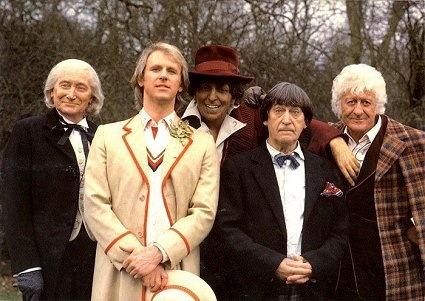
Promo picture for The Five Doctors: The man on the left is Richard Hurdall, who replaced William Hartnell as the first Doctor. From left to right: Peter Davison, Patrick Troughton, and Jon Pertwee. Behind them is a wax dummy of Tom Baker from Madame Tussards. Baker would not appear in the story.
Of course, the thing that has been keeping Terrance Dicks involved with Doctor Who the most since he left the program as script editor has been the writing of the novelizations. When Dicks left the show in 1974, only three stories had been novelized, Doctor Who and the Daleks and Doctor Who and the Crusaders by David Whittaker and Doctor Who and the Zarbi by Bill Strutton. Since then, many more stories have written in book form, most of written by Terrance Dicks. In fact, this year (1986) the one hundredth novelization was published, Doctor Who and the Two Doctors by Robert Holmes.
Dicks talked about how he goes about writing the novelizations. He said, "The actual technical thing is, now I have a script of the show, and now I have a video recorder in my office. I sit with the script and I play the program video and I write a few pages of the book. And I go along like that, maybe a chapter at a time. So, I refer constantly to both the script and the program because there are always things in the program that aren't in the script. Not in the sense of changes, but remember the script is written first, and does not describe the actual sets and costumes. It describes how the writer would like them. Perhaps, what the designer, or the costumer have designed is something totally different. So how things look , you have to get out of the program."
The writer went on to say, "I try to keep as faithful to the show as possible. Except there is a technique in television called inter-cutting parallel scenes. You'll cut from the Doctor to a companion, and you'll go A,B,A,B, A,B, and you'll have six short scenes. In a book you'll find that irritating. So, you put those scenes together. You go A, A, A, B, B, B, and you make two scenes out of six. So, it's that kind of thing, but the same stuff will be in those scenes."
In the past couple of years, Dicks has been able to do fewer novelizations than in previous years. One reason is the job he has as the script editor/producer of The Sunday Classics. However, Dicks himself has a better reason.
He said, "I don't have as many now as I use to. Because since the books are getting more popular many of the script writers are thinking, 'Hey, there's a good thing here; why should I let Terrance novelize my script. I can novelize my own script.' Which is fair, I mean, there was no way I would let anyone novelize "The Five Doctors," that was my script and my book. And a lot of people feel like that."
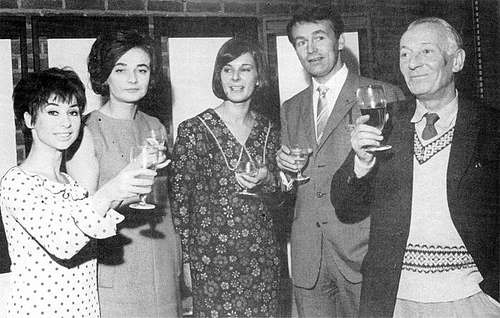 Carol Ann Ford, Jacqueline Hill, Verity Lambert, William Russell, William Hartnell at the party celebrating the end of the first series of Doctor Who.
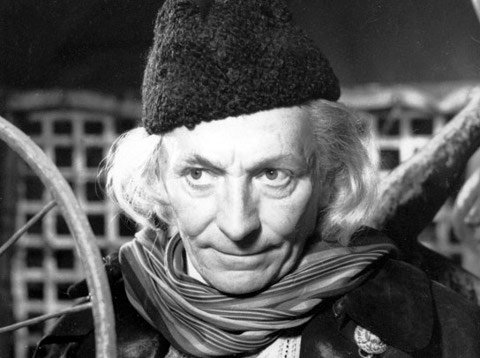
William Hartnell the first Doctor.
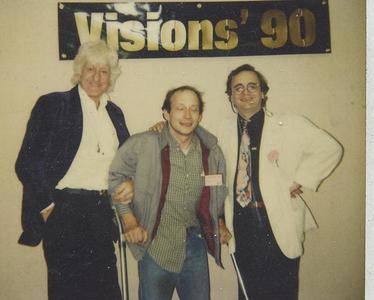
Me, with the third Doctor, Jon Pertwee and the seventh Doctor, Sylvester McCoy, Chicago 1990.
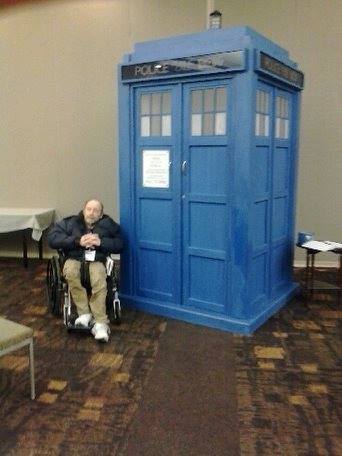
At the Chicago TARDIS Convention 2013